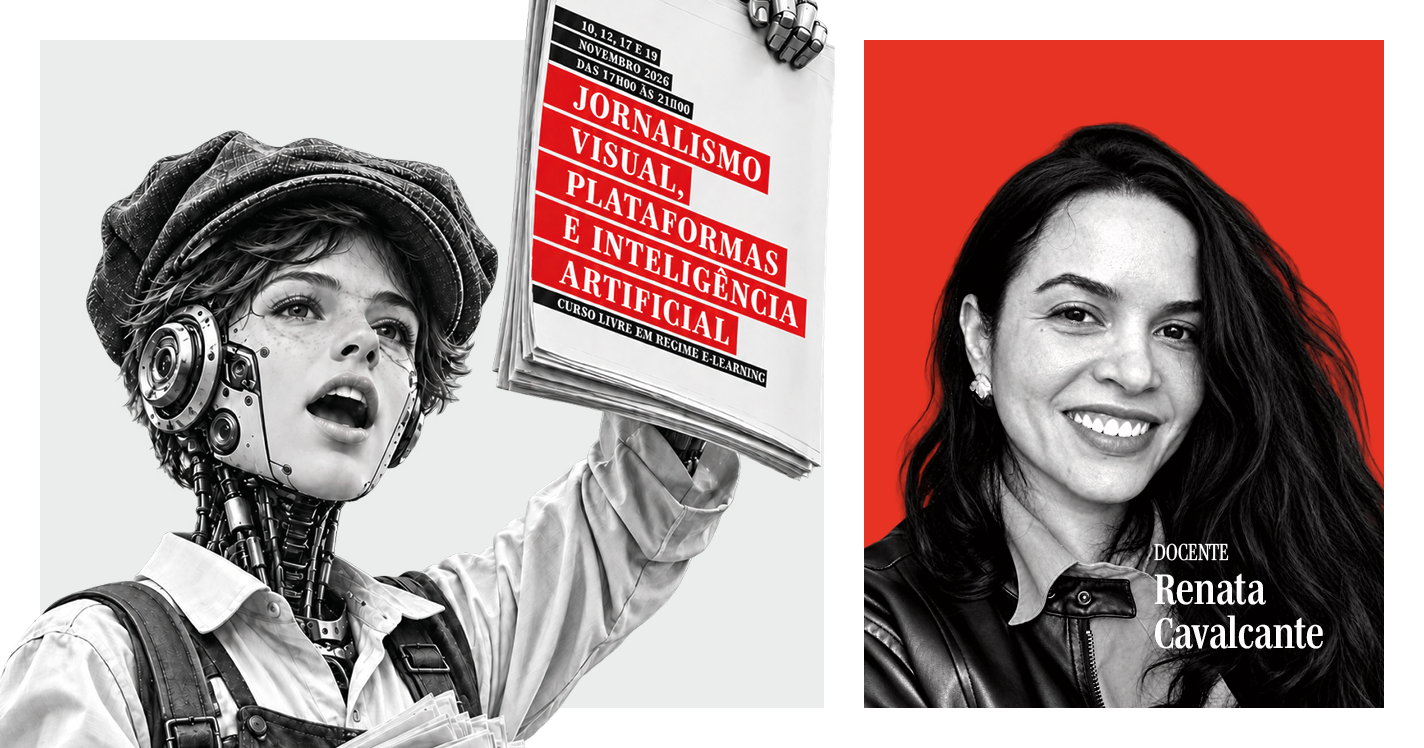
The e-learning short course “Visual Journalism, Platforms and Artificial Intelligence” proposes a critical reflection on the role of images in contemporary journalism, considering the impacts of digital platforms, algorithms and intelligences
artificial in the production, circulation and interpretation of information. Starting from the understanding of the image as a central operator of truth, credibility and symbolic dispute, it analyses the transition from documentary photography to the “dictatorship of the vertical format” (TikTok and Instagram Reels), investigating how rapid consumption and the imperative of engagement affect attention and public debate.
On 10, 12, 17 and 19 November 2026, from 17:00 to 21:00, this course examines the regimes of visibility produced by mapping devices and platforms, with a focus on the representation of territories, processes of symbolic erasure and media geography. It discusses visual disinformation, the use of generative AI in electoral contexts and visual ecologies in the digital age. The proposal combines frameworks from Visual Culture and Journalism with the analysis of empirical cases and practical exercises in critical reading and the creation of counter-narratives.
Professor Renata Cavalcante will be responsible for teaching the course. Renata Cavalcante de Oliveira is a researcher, a teacher of arts, audiovisual media and visual arts, and a creator of visual images/installations.
The course is intended for teaching staff, students and other collaborators of the Fernando Pessoa University.
Online registration will run until 25 October 2026.
Free registration, does not include a certificate of attendance.
Registration fee of €10, includes a certificate of participation.
Notice: the running of the course is subject to a minimum of ten enrolments.
Prior to the sessions, the appropriate access link for each session will be emailed to those registered.
PROGRAM
Session 1 - 10th November (Tuesday): From Document to Agency: Transformations of the Journalistic Image
Description: Analyses the transition of the image as proof and documentary evidence in journalism to its agency and materiality in the digital era, tracing the history of the gaze and the transformations of the technical support.
● The image as source, evidence and document: credibility and ethics in journalism (Benjamin, Barthes and Crary).
● From shutter to smartphone: the mobile phone as a capture tool and the spectacularisation of intimacy (Santaella and Sibilia).
● From representation to agency: the spectacle and the desire of images in the public sphere (Debord and Mitchell).
● Excavation and materiality of media: archaeology of supports and regimes of visibility (Parikka and Azoulay).
Session 2 - 12th November (Thursday): Platforms, Cartographies and Representation of Territories
Description: Examines how digital platform algorithms and automated mapping devices shape the circulation of news and affect the representation of urban space and peripheral subjects.
● Platforms as mediators: algorithms, the attention economy and the architecture of attention (Gillespie and Byung-Chul Han).
• Cartographies and surveillance: Google Maps, Street View and automated panopticism in the mapping of reality (Foucault and Latour).
● Territorial stigmatisation and media ecologies: the contributions of Iliana Esperanza Hernández García and Milton Santos.
● Technical images and Actor-Network Theory: networks of human and non-human actors in the news (Latour, Barad and Flusser).
Session 3 — 17 November (Tuesday): The Dictatorship of the Vertical Format, AI and Disinformation
Description: The impacts of vertical framing (TikTok/Reels), misinformation in political scenarios, and the ethical challenges of generative AI and synthetic content on journalistic credibility are investigated.
● The “Vertical Format Dictatorship”: fast consumption, loss of sustained attention and television journalism on TikTok (Kneipp & Oliveira; Crary).
● Disinformation and electoral ecosystem: memes, out-of-context images and the contest for public trust (Wardle).
● Generative AI and the “truth effect”: deepfakes, simulations and critical fabulation in the press (Floridi and Haraway).
● Hybridisation and the “phenomenology of the like”: the conflict between the public interest and the tyranny of engagement (Han and Bucci).
Session 4 — 19 November (Thursday): The Right to Look, Visual Ecologies and Counter-Narratives
Description: Explores the “right to look” and visual ecologies as tools for emancipation, culminating in a practical workshop on deconstructing framing and creating journalistic counter-narratives.
● The Right to Look (The Right to Look): visuality, power and the break with regimes of invisibility (Nicholas Mirzoeff).
Visual Ecologies and Proliferation: the circulation and enrooting of visual flows within the platform ecosystem.
● Critical reading and “poor images”: the power of the aesthetics of resistance and the popular register (Hito Steyerl).
Counter-Narratives Workshop: a collective practical exercise in reinterpreting and reframing stigmatised histories and territories.