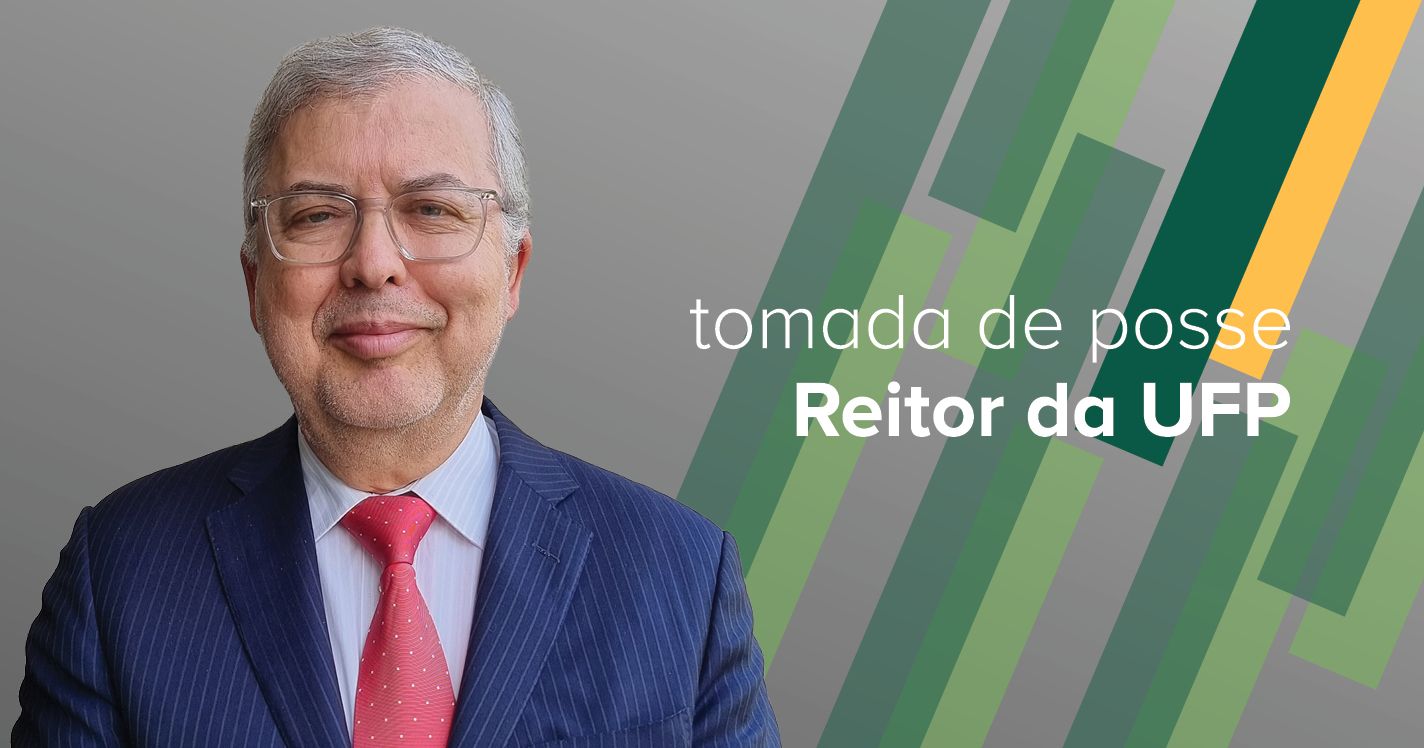
The inauguration ceremony for the Rector, Professor Eugénio Manuel de Faria Campos Ferreira, for the three-year period 2026–2029, took place on March 16th at 5:00 PM at the Fernando Pessoa University.
This institutional event marked the beginning of a new cycle of academic leadership at the Fernando Pessoa University and was attended by members of the academic community, faculty, students, staff, and guests.
The ceremony included a speech by the Chairman of the Board of Directors of the Fernando Pessoa Foundation for Education and Culture, Professor Salvato Trigo, who presided over the investiture of the new Rector, as well as a speech by the President of the Academic Association, student Leonor Marques.
The session also included a musical performance by the Fernando Pessoa Women's Tuna group, followed by a speech from the new Rector and the closing of the ceremony.
CV
Eugénio Campos Ferreira holds a degree in Chemical Engineering (1986) and a PhD in the same field (1995) from the Faculty of Engineering of the University of Porto. He conducted doctoral research at the Université Catholique de Louvain, completed postdoctoral studies at the Universitat Autònoma de Barcelona, and spent a sabbatical period at the University of California, San Diego. He has been a Full Professor in the Department of Biological Engineering at the University of Minho since 2010, an institution where he began teaching in 1991. Between 2019 and 2025, he served as Vice-Rector for Research and Innovation at the University of Minho. He was President of the Board of Directors of TecMinho — University-Business Association for Development, between 2020 and 2025, and Vice-President of the Board of Directors of CENTI — Center for Nanotechnology and Technical, Functional and Intelligent Materials, between 2022 and 2025. He was a member of the General Council of the University of Minho in the periods 2017-2019 and 2025-2026. He directed the Center for Biological Engineering between 2016 and 2020, then the largest research unit of the University of Minho, with approximately 400 researchers, classified as “Excellent” in the evaluation of the Foundation for Science and Technology. He leads the BIOSYSTEMS research group, dedicated to Bioprocess Engineering and Biosystems Computing, developing research in the field of Process Systems Engineering and Systems Biology applied to biotechnological and environmental processes. In the academic field, he was Director of the Doctoral Program in Bioengineering between 2011 and 2021, as well as Director of the Bachelor's Degree in Biological Engineering and the Master's Degree in Environmental Management. He also served as Vice-President of the School of Engineering at the University of Minho, responsible for research, and as Deputy Director of the Department of Biological Engineering. He is a member of the Academy of Engineering and a member of the Board of Directors of the Order of Engineers, where he chaired the National Council of the College of Chemical and Biological Engineering. He was Secretary-General of the Portuguese Biotechnology Society for fifteen years and represented Portugal on the Technical Committee on Biosystems and Bioprocesses of the International Federation for Automatic Control. He regularly participates in scientific and organizing committees of international congresses, holds editorial positions in specialized scientific journals, and is an evaluator for several national and international agencies, including the Foundation for Science and Technology, the National Innovation Agency, the European Commission, and the Agency for Assessment and Accreditation of Higher Education. He has supervised 16 doctoral theses and is the author or editor of 13 books, as well as the author of approximately two hundred scientific articles and book chapters. He has actively participated in the reflection and reform of research evaluation models, aligning them with principles of scientific relevance, transparency, and societal impact, within the scope of his intervention as co-coordinator of the national chapter of CoARA. He is a proponent of open science practices and the valorization of knowledge as a structuring pillar of the scientific and technological system.