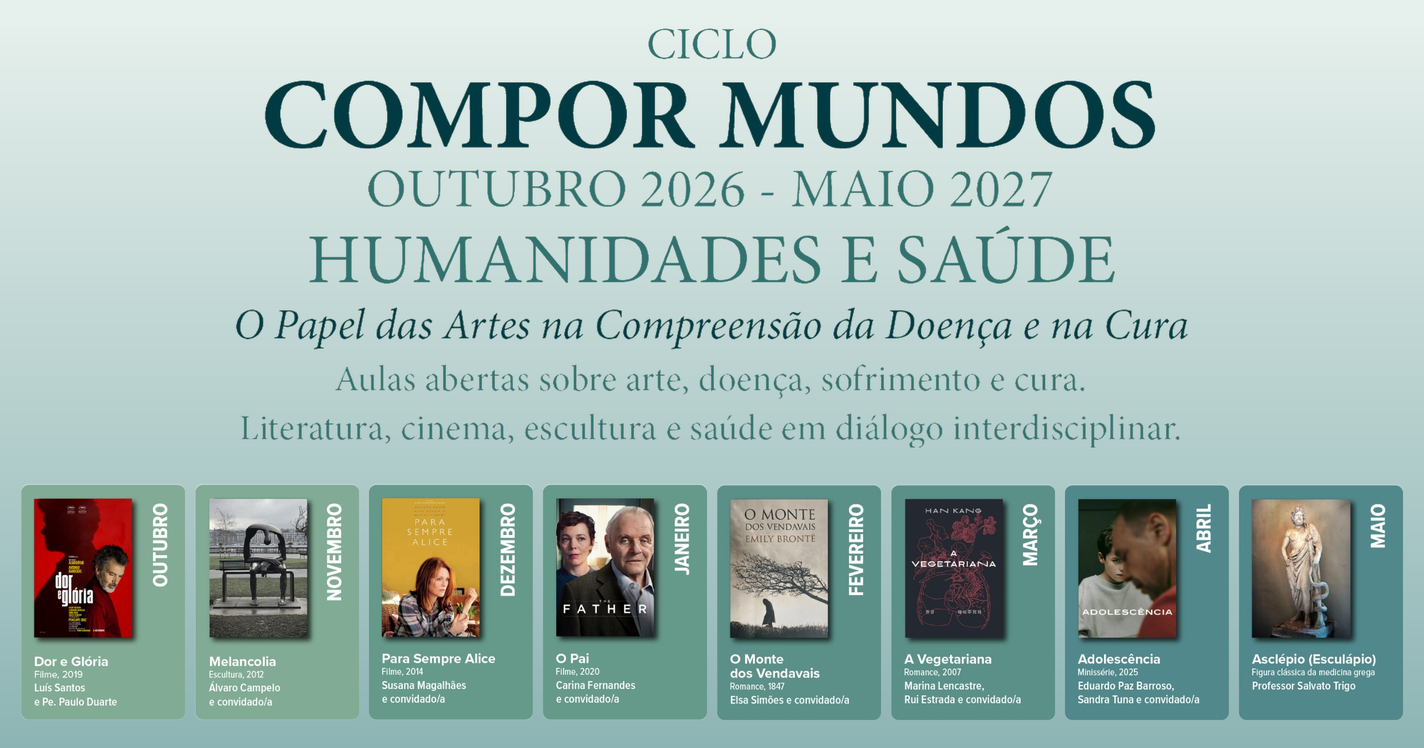
The Fernando Pessoa University will host, between October 2026 and May 2027, the Cycle Composing Worlds 2026–27, dedicated to the topic “Humanities and Health. The Role of the Arts in Understanding Disease and in Healing”. The initiative proposes an interdisciplinary reflection on illness and care, based on eight works of cinema, literature, and sculpture.
By bringing the Humanities and the Health Sciences closer together, the cycle seeks to deepen the understanding of the experience of illness, integrating its cultural, social, historical, and existential dimensions. The dialogue with the arts allows for exploring suffering, recovery, closeness to death, and the sense of living, contributing to a practice of care that is more attentive to human complexity.
The works will be presented and discussed by experts from various fields, creating opportunities to discuss topics such as stigma, identity, vulnerability, mental health, caregiving relationships, and the ethical challenges of clinical practice. This course will also allow for reflection on diagnoses, treatments, and healthcare institutions in the contexts in which they operate.
The program includes the following works:
- October: Pain and Glory, With Luís Santos and Father Paulo Duarte;
- November: Melancholia, with Álvaro Campelo and guest/guest;
- December: Forever Alice, with Susana Magalhães and guest/s;
- January: The Father, with Carina Fernandes and guest/s;
- February: The Mount of the Vendavais, with Elsa Simões and guest/s;
- March: The Vegetarian, with Marina Lencastre, Rui Estrada and guest/s;
- April: Adolescence, with Eduardo Paz Barroso, Sandra Tuna and guest/s;
- May: Asclepius (Esculapius), With Professor Salvato Trigo.
The sessions are open to the academic community, professionals, and the general public., It takes various forms, such as round tables, seminars with guiding questions, workshops on reading commentary and analysis of clinical-cultural cases.
The cycle will also give rise to the ebook Composing Worlds: Arts and Health, This event will bring together the communications and reflections of the participants, as well as the pedagogical methodologies used in the sessions, extending the initiative’s contribution to the debate on the humanization of healthcare.